“AI is just a hype.” I still hear this occasionally. The argument usually goes something like: sure, AI can do some simple tasks, but it’s not really useful for anything serious, and it will fade once the novelty wears off.
I used to be more sympathetic to this view. But after living with AI tools for the past couple of years, I’ve come to a different opinion: AI is no longer a hype. It has quietly and fundamentally changed how I work, how I learn, and how I build things. The shift didn’t happen overnight — rather, it crept in one workflow at a time, until I looked back and realized that many things no longer work the same way they used to.
AI Changed How I Write#
This was the first thing to change. Since ChatGPT, I stopped writing emails from scratch. I describe what I want to say — the key points, the tone, the context — and AI drafts it. I review, adjust if needed, and send. It’s particularly useful when I need to respond to emails in languages I don’t speak — AI produces decent translations much faster than I could on my own.
This might sound trivial. Emails are not complex. But that’s exactly the point — AI didn’t start by solving hard problems. It started by eliminating friction from everyday tasks. And once that friction is gone, you don’t go back.
Nowadays, AI does most of my writing, not just emails. I describe what I want to write, lay out the ideas and key points I have in mind, and AI produces a decent draft. The final version still requires my curation, but AI has sped up the process enormously. For me, the hard part of writing has always been the beginning: organizing isolated thoughts into a coherent, structured essay. AI handles that cold start, and from there I refine. It goes without saying that AI is also a great proofreader who can help with last-mile polishing.
AI Changed How I Learn#
I live in Zurich, Switzerland, where German is the most widely spoken language. When I started learning German, I relied on online courses, textbooks, and dictionaries. They were good starting points, but something was always missing: immediate feedback. I could memorize vocabulary and study grammar rules, but I had no way to know whether I was actually using them correctly until I talked with someone.
AI filled that gap. Now when I write a German sentence, I can instantly ask whether it’s correct and idiomatic, and if not, why. I get not just corrections but explanations — the kind of feedback that would normally require a tutor. AI can’t fully replace a human tutor, but it has largely bridged the gap.
The same applies to technical learning. When I need to pick up an unfamiliar technology, I no longer spend hours reading documentation and tutorials from scratch. I describe what I’m trying to do, and AI explains the relevant concepts, points me to the right patterns, and answers follow-up questions as they come up. The feedback loop is immediate — I learn by doing, with AI filling in the gaps in real time.
AI Changed How I Build#
This is the most profound shift. In my previous post, I wrote about software engineers transitioning from coders to orchestrators, which is how I work every day.
With coding agents like Claude Code, I no longer start a task by reading through the codebase myself, tracing dependencies, and writing code line by line. Instead, I describe what I want to achieve, and the agent reads the code, understands the context, and produces a solution. My role is to review its work, provide direction when it’s off track, and make the judgment calls that require understanding the bigger picture.
Most of the time, it does a genuinely good job. Sometimes it gets into a dead end — looping on an approach that isn’t working, or misunderstanding a subtle requirement. When that happens, I clear the context and ask it to retry with a bit more guidance. This simple loop — delegate, review, course-correct — is remarkably effective.
Building at Unprecedented Speed#
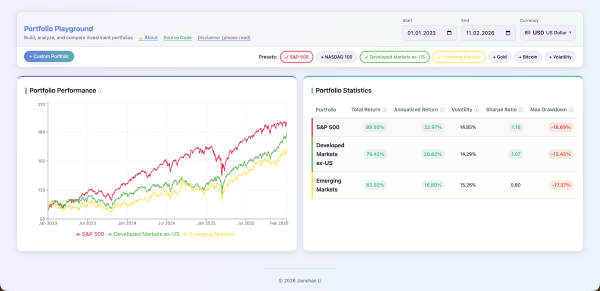
AI has helped me build side projects at a pace I couldn’t have imagined before. Portfolio Playground, for example, went from idea to deployed product in a single weekend — built entirely through vibe coding, with 100% AI-generated code. The technologies involved — Next.js, TypeScript, FastAPI — were things I had never worked with, yet that didn’t matter. I focused on what the product should do, and AI handled the implementation. The result was a product I’m genuinely happy with, more feature-rich than I originally planned.
Debugging Unfamiliar Codebase#
AI has also become my go-to for debugging in unfamiliar codebases. Previously, when I hit an issue in code I didn’t write, I’d spend a lot of time reading through it or, more often, ask a colleague who knew the codebase better. That dependency — needing someone else’s time and knowledge — was a bottleneck.
Now I point the agent at the codebase, describe the issue, and let it investigate. It reads through the code far faster than I can, traces the relevant paths, and proposes fixes. It’s not always right on the first try, but it dramatically narrows the search space. Problems that used to require asking for help are now problems I can solve independently.
A Great Partner for the Introverted#
There’s a more personal dimension to this. As an introvert, asking people for help has always carried a cost — not because people aren’t willing, but because the act itself requires energy, especially navigating the social dynamics of asking for someone’s time.
AI has none of these costs. It is patient, it is helpful, it never gets annoyed, and it always tries its best to help. This isn’t about replacing human connection — it’s about having a partner that complements how I naturally work. For tasks where I used to hesitate before asking someone, I now just ask AI. The barrier to getting help has dropped to near zero.
Why the “Hype” Label Persists#
If AI is this useful, why do some people still call it a hype? I think there are a few reasons.
Some haven’t tried it seriously. Many have used AI once or twice — asked it a question, got an imperfect answer, and concluded it’s not useful. But AI’s value compounds with consistent use. You learn what it’s good at, how to prompt it effectively, and how to integrate it into your workflow. A single interaction doesn’t capture this.
Some expect perfection. AI makes mistakes. It hallucinates. It sometimes confidently produces wrong answers. For people who expect a tool to be right 100% of the time, these failures are disqualifying. But this sets an unrealistic bar — one we don’t even apply to human collaborators. The question isn’t whether AI is perfect, but whether it makes you more effective overall.
Some compare it to the wrong benchmark. The right comparison isn’t “AI vs. expert human doing this specific task.” It’s “me with AI vs. me without AI.” When I frame it this way, the improvement is undeniable.
Some are naturally cautious about new technologies. This is understandable — and not new. When trains first appeared, people feared they would cause all sorts of harm. Electricity was first met with deep suspicion. Early aviation was widely dismissed as impractical. In each case, skepticism eventually gave way to adoption as the technology proved its value in everyday life. AI is following the same pattern.
Final Thoughts#
AI is no longer a hype. It is a practical reality that is already reshaping how people live and work. For me, the evidence is simply my daily experience: AI changed how I write, how I learn, and how I build — and as an introvert, it has become a great partner that fits my working style.
Unlike many technology trends that come and go, this one compounds — the more you use it, the more you learn how to use it, and the more effective it becomes. That’s not the trajectory of a hype. That’s the trajectory of a fundamental shift.